

CO2 Solenoid Valves Compared - Automating Your Photoperiod
A CO2 solenoid is an electronically controlled valve that opens and closes the gas path between your regulator and your diffuser. On its own it does nothing special: gas either flows or it doesn't. Paired with a timer or controller, it is what lets CO2 run only during the hours your plants are actually photosynthesizing, instead of bubbling away all day and night. Almost every automated planted tank relies on one, whether built into the regulator or added as a separate part.
There are five solenoid setups worth knowing: standalone inline valves, regulator-integrated units, AC mains-voltage models wired to a timer, low-voltage DC models wired to a controller, and smart WiFi-enabled modules. Below is a full comparison of how they work, what they cost, and which setups they suit best.
How a CO2 solenoid actually works
A solenoid valve uses an electromagnetic coil to move a small internal plunger that blocks or opens a gas passage. Most aquarium solenoids are normally closed, meaning gas is blocked by default and only flows while the coil is energized, which is the safer failure mode: if power drops, CO2 stops rather than free-flowing. The coil can run on standard AC mains voltage, wired straight to an outlet timer, or on low-voltage DC, wired to a controller or microcontroller-based dosing system that can layer in schedules, pH-based cutoffs, or app control. Response is effectively instant, so the solenoid itself doesn't affect bubble rate, only whether gas is flowing at all.
Comparison at a glance
| Solenoid type | Control input | Fail-safe behavior | Install complexity | Typical cost | Best setup |
|---|---|---|---|---|---|
| Inline standalone | Manual timer or switch | Normally closed (gas stops on power loss) | Medium, splices into gas tubing | $15-40 | Adding automation to an existing regulator |
| Regulator-integrated | Manual timer or switch | Normally closed (gas stops on power loss) | Low, built in from the factory | Included in regulator price, or $20-60 more | New regulator purchases |
| AC mains-voltage | Outlet timer | Normally closed (gas stops on power loss) | Low, plugs straight into a timer | $15-35 | Simple on/off scheduling with lights |
| Low-voltage DC | Aquarium controller | Normally closed (gas stops on power loss) | Medium, needs a compatible controller | $20-50 (plus controller cost) | Automated setups already using a controller |
| Smart WiFi module | App or smart-home schedule | Normally closed (gas stops on power loss or lost connection) | Medium, needs WiFi setup | $35-90 | Remote monitoring and schedule changes from a phone |
Inline standalone solenoid valve

This is a solenoid sold on its own, meant to be fitted into the CO2 tubing between a regulator that lacks a built-in solenoid and the rest of the system.
Properties
- Adds automation to any existing regulator without replacing it.
- Requires cutting into the gas line and adding barbed or threaded fittings.
- Works with either AC or DC coil versions, depending on the model purchased.
- One more fitting in the line means one more place to check for leaks.
- A budget-friendly way to automate a setup built around an older or simpler regulator.
The main appeal is flexibility: it lets you upgrade automation later without buying a whole new regulator.
Regulator-integrated solenoid

Many mid-range and premium regulators come with a solenoid built into the body itself, positioned after the needle valve or working pressure stage, controlled by the same power lead.
Properties
- Fewer fittings overall than adding a standalone solenoid, which means fewer potential leak points.
- Neater installation with one unit instead of a regulator plus a separate valve.
- Not upgradable or replaceable on its own if it fails, since it shares the regulator's housing.
- Usually costs a bit more upfront than a regulator without one, though often less than buying a bare regulator and a standalone solenoid separately.
- The standard choice for anyone buying a new regulator for an automated tank.
Buying a regulator with this built in from the start is usually simpler and neater than retrofitting a standalone valve later.
AC mains-voltage solenoid
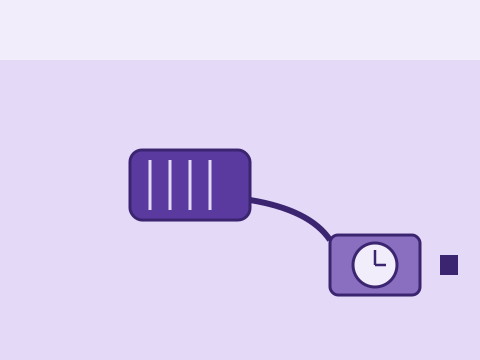
This is the most common consumer setup: a solenoid coil built for standard wall voltage, plugged into a simple mechanical or digital outlet timer alongside the tank lights.
Properties
- Works with any basic plug-in timer, no aquarium-specific controller needed.
- Simplest possible automation: set the timer once and CO2 follows the light schedule.
- Carries mains voltage right next to a tank, so proper plugs and drip loops matter.
- No ability to layer in extra logic, like pausing CO2 during a water change, without a smarter timer or controller.
- Inexpensive and available on nearly every regulator and standalone solenoid on the market.
The right choice for anyone who just wants CO2 on during the day and off at night, with nothing more complicated than that.
Low-voltage DC solenoid
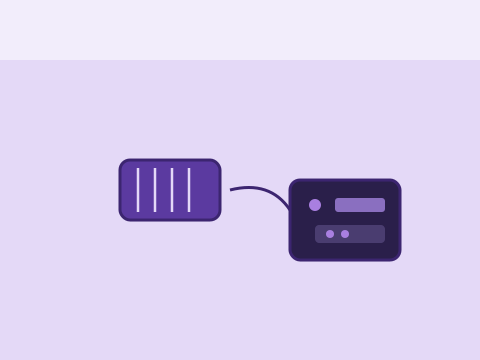
Built for lower, safer voltages, this style of solenoid is driven by a dedicated aquarium controller or dosing system rather than a wall timer, opening up more automation than on/off alone.
Properties
- Runs on safer low voltage, which matters given the proximity to water.
- Enables logic beyond a simple schedule, such as pausing CO2 if pH drops too fast or too far.
- Requires owning or buying a compatible controller, which adds to the total cost.
- Wiring is a bit more involved than a plug-and-play mains timer setup.
- Popular in reef and high-tech planted tanks that already run a controller for other equipment.
Worth it if you already have, or plan to get, a controller managing other parts of the tank, since the solenoid becomes just one more device on the same system.
Smart WiFi solenoid module

The newest category: a solenoid paired with a WiFi-enabled controller module, letting you check status and adjust schedules from a phone app rather than a physical timer or dial.
Properties
- Schedule changes and manual overrides are possible remotely, without touching the hardware.
- Some models can send alerts if the valve fails to close or loses power.
- Depends on a stable home WiFi connection and, for some models, a cloud service staying online.
- Defaults to normally closed if connectivity or power is lost, so a dropped connection fails safe.
- Costs more than a basic mains or DC solenoid for the added convenience.
A good fit for keepers who travel often or manage multiple tanks and want to check or adjust CO2 schedules without being physically present.
Choosing the right solenoid for your tank
A few practical factors should drive the decision more than brand preference:
- What your regulator already has. If it includes an integrated solenoid, there is usually no reason to add a standalone one; if it doesn't, a standalone inline unit fills the gap.
- How much automation you want. A simple mains-voltage solenoid on a timer covers basic on/off scheduling; a low-voltage DC or smart module suits setups wanting extra logic or remote control.
- Existing equipment. If a controller is already running lights, dosing, or other gear, a low-voltage DC solenoid that plugs into the same system is usually the most efficient choice.
- Remote access needs. Frequent travel or multiple tanks make a smart WiFi module worth the premium; a tank checked daily in person rarely needs it.
- Budget. AC mains-voltage solenoids on a basic timer are the cheapest reliable automation; smart modules and controller-based setups cost more but add flexibility.
Maintenance tips that apply to every type
- Test that the solenoid fully closes when power is cut by listening or watching the bubble counter, since a solenoid stuck open will drain a cylinder and overdose CO2 overnight.
- Check gas fittings around any inline solenoid for leaks with soapy water whenever the line is disturbed.
- Keep timers, controllers, or WiFi modules away from splash zones, and use drip loops on any mains-voltage cabling near the tank.
- Periodically confirm the schedule is still correct after power outages, since some mechanical timers lose their programmed time when power drops.
- If using a smart module, check that its offline or fail-safe behavior is actually normally closed before trusting it unattended.
Final thoughts
There is no single best CO2 solenoid, only the best one for how your system is already built and how much automation you want. Regulator-integrated solenoids are the cleanest choice when buying new equipment, while standalone inline units let you retrofit an existing regulator. AC mains-voltage solenoids cover basic light-synced scheduling for most tanks, and low-voltage DC or smart WiFi modules earn their higher cost on setups that already lean on a controller or need remote access. Match the solenoid to your regulator, your existing automation, and how hands-off you want CO2 dosing to be, and the rest of the schedule takes care of itself.